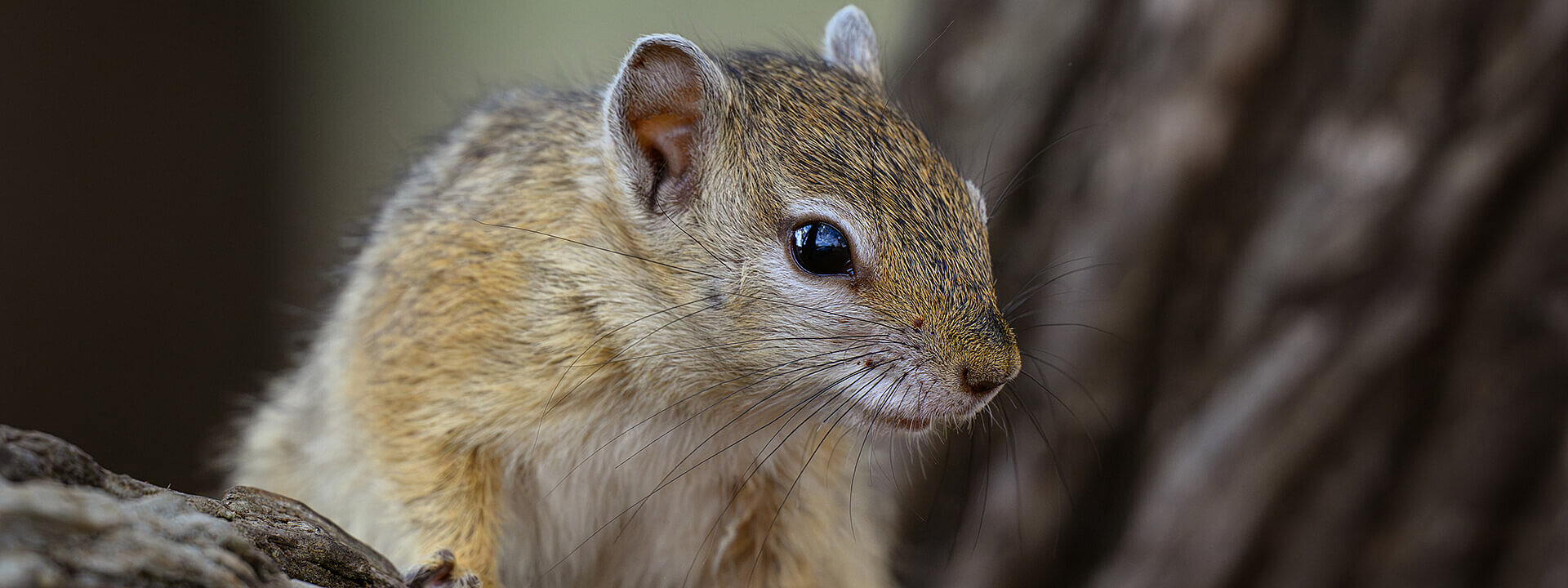
Smith's bush squirrel
Paraxerus cepapi
IUCN red list status:
Least Concern
For more informations, please visit iucnredlist.org

Primarily herbivorous, but have been known to eat some insects.
Found in the southern Central Africa and East Africa with some northern parts of South Africa.

They give birth to 1-3 pups with a gestation of 56 days.
Smith's bush squirrel
This is an arboreal small squirrel species, but will spend a lot of time on the ground to forage for food. Bush squirrels will use their forefeet to manipulate the ground and food items when feeding. They will hoard and bury seeds next to tree trunks and grass tufts and this helps with seed dispersal. As a diurnal species and will spend night time nested together within their territorial family groups in the holes of mopane trees, which seems to be their favourite tree to nest in. Males are responsible for territory defense whilst the females will care for the young. To help with group bonding, the individual squirrels will groom one another and share a common scent.
Did you know?
Their fur colour is dependent on their distribution and where they are found. In drier, western areas their fur is light grey. Whereas in the eastern areas it appears more brown. But their belly is always white.